
The Medical Device Development Process: From Idea to Market
Updated: Sep 21
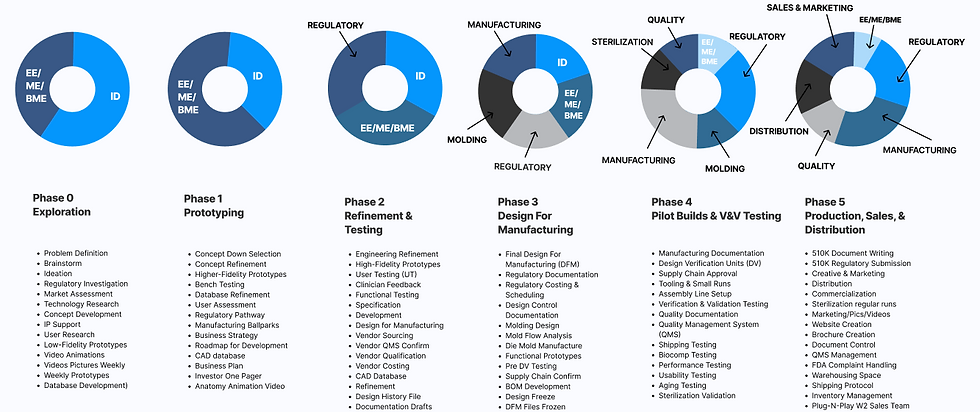
Bringing a medical device from an initial idea to a market-ready product requires coordination across engineering, prototyping, regulatory, manufacturing, and commercialization. At Voltas, our integrated approach brings every stage together under one roof, helping reduce delays, improve communication, and accelerate development.
Phase 0: Exploration & Concept Development
Every successful medical device starts with a clear understanding of the problem.
During this phase, teams focus on:
Defining the clinical need and product goals
Market and technology research
Regulatory pathway evaluation
Concept development and feasibility
User research and feedback
Initial prototypes and design concepts
Early engineering assessments
Phase 1: Prototyping & Design Development
Once a concept is defined, ideas begin turning into physical prototypes.
This phase includes:
Concept refinement
Industrial design development
Engineering design
CAD modeling
Prototype builds
Bench testing
User evaluations
Regulatory strategy development
Material and component selection
Phase 2: Refinement & Testing
With prototypes in hand, the focus shifts toward improving performance, usability, and manufacturability.
Key activities include:
Engineering refinement
High-fidelity prototypes
User testing and clinical feedback
Design verification planning
Manufacturing considerations
Supplier evaluation
Design history documentation
Cost analysis and optimization
Phase 3: Design for Manufacturing (DFM)
A successful device must be designed not only to work, but to be manufactured consistently at scale.
This phase includes:
Final design refinement
Manufacturing documentation
Quality documentation
Regulatory documentation
Design controls
Mold design and development
Tooling development
Process development
Supply chain planning
Production planning
Phase 4: Pilot Builds & Verification Testing
Before full production, devices undergo rigorous testing and validation.
Activities include:
Pilot manufacturing builds
Design verification testing (DVT)
Process validation
Supplier approvals
Packaging development
Shipping testing
Biocompatibility testing
Performance testing
Usability testing
Sterilization validation
Phase 5: Regulatory Submission & Manufacturing Launch
After successful testing, the device moves toward regulatory approval and commercialization.
This phase includes:
Regulatory documentation preparation
510(k) or applicable regulatory submissions
Manufacturing scale-up
Quality system implementation
Document control
Packaging and labeling
Production planning
Inventory management
Commercialization preparation
Phase 6: Commercialization & Business Operations
Launching a device requires more than manufacturing, it requires ongoing support.
Commercial activities include:
Quality management
Warehousing and distribution
Sales support
Marketing and branding
Digital marketing
Training materials
Product documentation
Inventory management
Customer support
Growth strategy
Why an In-House Approach Matters
Medical device development has many moving parts. When teams are spread across multiple companies, communication gaps can slow progress and create unnecessary challenges.
That is why Voltas was built around one simple idea:
Everything. In. House.
By combining engineering, prototyping, regulatory, manufacturing, and commercialization under one roof, we help companies simplify development and bring better medical devices to market faster.
Have a medical device idea? Get in touch with Voltas to learn how we can help bring it to life.


Comments